
Preface: A painting should speak for itself. As a visual medium, it can convey aesthetics and meaning in ways that land differently for every viewer — and that’s precisely its power. If you could fully capture a painting in words, why paint at all?
With that in mind, what follows are notes on two paintings. Think of them less as explanations and more like liner notes on a vinyl record: a little context about why and how something came to be, offered in the hope that it adds something without replacing the work itself.
Portrait of a Lamp
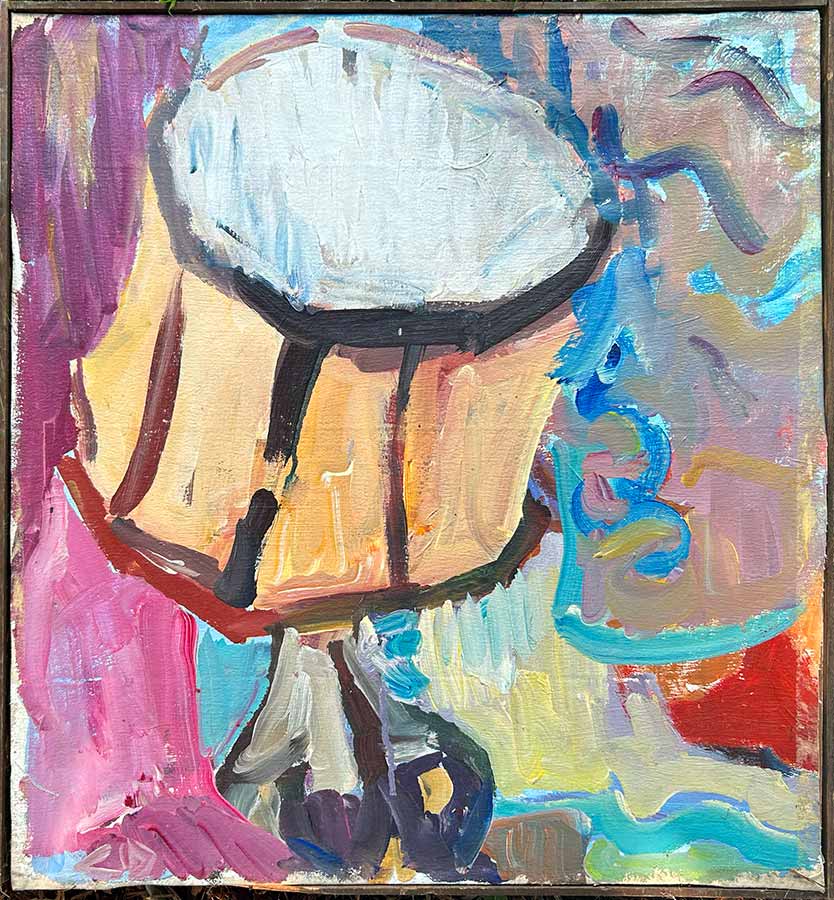
This is the painting where I thought I finally understood many of the concepts of what I was being taught about painting, both in the choice and symbol insinuations of the subject matter, and in the abstract elements of geometry, balance, the flat picture plane, and in the science of perception of reflected and projected light and color.
The painting is called Portrait of a Lamp. It was painted in 1986. Acrylic on Canvas mounted on Plywood.
The Personality of Objects
I understood that some objects have personalities, and some because of their construction, use, and built-in symbolism have more of a persona than other objects. This lamp has an attitude with it’s cocked shade and loose paint treatment. It is hip or sly, not formal nor static. It has a face, a head, and a body. It projects light and illuminates the space it inhabits. Light is often used as term for life (the light in one’s eyes), for a soul (the light has left the body), for consciousness and enlightenment, and for God or a spirit.
That the lamp has a personality or a presence of a being, should not be confused with anthropomorphism –a Disney teapot with a face and a talking mouth – but understood instead as an extension of our own consciousness. The world we see is a recreation in our brain of the things we encounter, the spaces we live in and travel through, and the interactions with other creatures. The world of objects is alive because that world is, in a real sense, our mind. Objects shift, change, and grow as our memory of them changes over time and in the recreation of recollection.
Flatness and Space
We were taught how flatness was a central goal of many of the NY School painters of the 1950’s. The illusion of depth was considered a lie— a ruse, a trick— that needed to be avoided, and flatness accentuated. Truth was in the flatness of the picture plane. What these artists failed to recognize, as they pursued this idea to its extreme, was that the magic of a picture from the beginning of picture-making is the illusion of depth. Space in a painting, is space in our minds. It confounds us because we know the painting is a flat object, yet there exists a multi-dimensional world of space in, on, and through that flat plane. Space is a beautiful thing and if you throw it away, you have thrown away much of that which makes a painting interesting and arresting.
It is the interplay between the two-dimensional shapes of the composition, and the three-dimensional space that makes a great painting.
When I painted the lampshade, I realized the flatness of each plane of the lampshade was being remade in the flatness of the canvas — the dimension of the picture plane itself. The canvas was now the flat, translucent membrane of transmitted light. In scientific terms, this was also true of the materials of both the lamp and the painting. This parallel holds in a precise way:
In a lamp the light passes through the shade, filtering, scattering and diffusing some of the light and colors, while allowing others to pass through.
In the painting, the light of the room hits the surface, and some of the light reflects, some is absorbed, and some passes through the thin colored paint layer and bounces off of the white ground/priming of the canvas and projects back through the colored plastic membrane of the pigments.
In a very real sense, the painting surface, the plastic unbroken membrane of the paint, became the same thing as the lampshade: a source of illumination, of light.
The Circle, the Void, and the Light
There is also the confounding of flatness, the circle of the top of the shade where we see down into the head, into the consciousness of the lamp. The bulb itself is hidden, but we see its result: the fountain of light erupting from an unseen source. That circle is simultaneously a hole in space and a flat oval on the canvas.
The bars and struts that form the support of the shade recalled a verse in the Tao Te Ching (Verse 11, Witter Bynner translation):
Thirty spokes will converge in the hub of a wheel, But it is the hole in the center that makes it useful.
I painted these supports like a cartoon stance — a brow and nose ridge— with the energy of animated emotion strokes, as a statement, a caricature of the head of the lamp rendered as display punctuation: bold, declarative, with an unflinching strength.
The darkest parts of the structure support the lightest: contrast and illumination coming together in a contained yet endless explosion of light.
The Surrounding Space
The surrounding space of the curtains, one magenta and one a patterned blue, wrap and weave through the shallow space, behind, in front, and adjacent to the lamp. They are planes of material that break apart into patterns yet hold like momentary veils of colored smoke or vapor.
Certain holes, spaces, areas of escape that promise more —the area at the lower right of the shade and the blue triangle below the left-bottom of the shade — function as portals to further unknown spaces of intrigue, inspired by the luminous ones in forests and glades in Charles Burchfield’s paintings, or by science-fiction.
Further
This painting felt like I was finally in the driver’s seat and in gear. Every stroke was purposeful, full of meaning and play — serious yet loose, dancing between the realities of two and three dimensions and understanding how meaning and sensuous enjoyment could synchronize into illumination.