
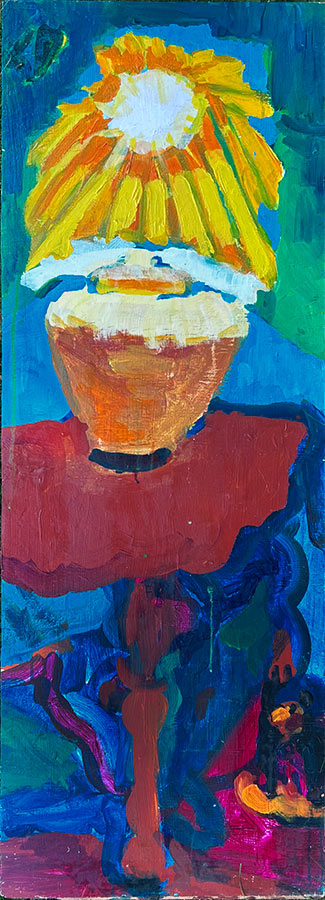
1000 Dollars
My next lamp painting was another milestone in my development as a painter.
I used a different lamp, set it on a small old end table, and placed a penguin stuffed animal underneath.
I again wanted to explore light, and how to paint light along with its many associations.
This was painted in one session from a still life set up in my studio.
The Lampshade as Multi-View
I painted the lampshade as a flattened, multi-perspective form: simultaneously seen from the side and from above, looking down into it. As I painted, I realized the perspective might also be from inside the lamp looking out. Flatness offers a perspective that is not fixed — one may be outside the objects, or the painted surface may become the membrane we are looking through from within.
This is reality, as the world of objects we see and remember is in our minds as a reconstruction, a recreation, and so we are inside those objects looking out.
The Exclamation
As I painted the whole picture it felt like an exclamation, and the center table leg and lampshade center almost form an exclamation point.
The light of the lamp is balanced by the dark, almost black (I never used actual black paint in this period, but made colors close to black by mixing the darkest blues, purples, greens and reds) single stroke at the base of the lamp, the foundation of the lamp meeting the table, a point hidden from the light by the lamp’s own form, the shape of the lamp base. Light is the source and creator of shadow.
Symbolism Baked into Reality
I realized after I painted this that symbolism is embedded in reality itself. I had unintentionally stumbled on a natural balance.
The lampshade is the sun, beaming out in graphical cartoon rays of yellow and orange. The table is the earth, brown like soil —a stable surface that divides above from below.
Beneath the table lie rich blues, greens, and violets: the ocean, or the underworld — areas of shadow, partially visible, with depths that remain unknowable.
The penguin is of the ocean, and of the underside of the world, quiet and mysterious, an observer and participant of its realm.
The blue curtain behind the lamp is the sky.
There is a second symbolic reading as well: the entire painting is a being, with a head of light and intelligence, a body browned by the sun with visible bone legs, and a murky subconscious filled with shapes and thoughts. The painting is an unusual dimension (for a traditional post-renaissance rectangle) but one fitting of a human body.
The Paint
The painting is acrylic on primed plywood — used plywood, specifically, which I prefer for the unexpected character the wood brings to the surface: not just grain, but knot holes, dents, and scratches that become part of the composition whether I plan for them or not.
The lamp itself is painted with thick, deliberate strokes, while the spilling light is rendered as thin washes that drift across the surrounding areas. Those thick strokes do double duty: formally, they describe the folds and planes of the lampshade, but physically, they are the light — the heaviest impasto in the painting reserved for what is, by nature, the most weightless thing in the scene. I was drawn to that contradiction: making light the most material substance in the work, the most tangible, while it remains the most ethereal.
The Color
Color presented its own conceptual problem. Rather than try to match the scene’s actual colors, I established a white balance of my own invention — declaring the titanium white of the lamp’s center opening to be the color of light itself, the axis from which everything else is calibrated. All other colors in the painting exist in relation to that assumption. Typically a white light tends toward warm or cool, and the color of the shadows fall in relation to that perception, but if the white is completely neutral then all colors can be pure. This allowed me to use some colors unmixed and straight from the tube: unmodified single pigments.
The tabletop at the center of the composition gave me particular pleasure: I was painting wood brown, while depicting brown wood — medium and subject briefly, satisfyingly, the same thing.
The Title
I titled this painting 1000 Dollars because it reminded me of the singularity of physical money — where value is unified into a singular object that takes on a personality of its own. A buck, a sawbuck, a ten-spot, a bit, a Ben Franklin, a C-note, a grand; none of these translate in the mind into what they could buy, or as a fraction of some larger sum. They exist as characters. Money has a face, and a backside or tail.
Through this painting I came to see how ordinary objects can hold layered meaning, and how paint and surface, when they find their balance, can resolve into something that feels less made than arrived at.